Your AI Red Team.Always Hunting.
AI-driven offensive security platform for recon, exploit intelligence, engagement orchestration, autonomous remediation, and pentest reporting, with an MCP server that lets your AI assistant run the workflow.
Inside the product
Command Every Security Engagement
These screenshots show the Reaper macOS application for coordinating engagements, evidence, assets, incidents, remediation, and autonomous security work.
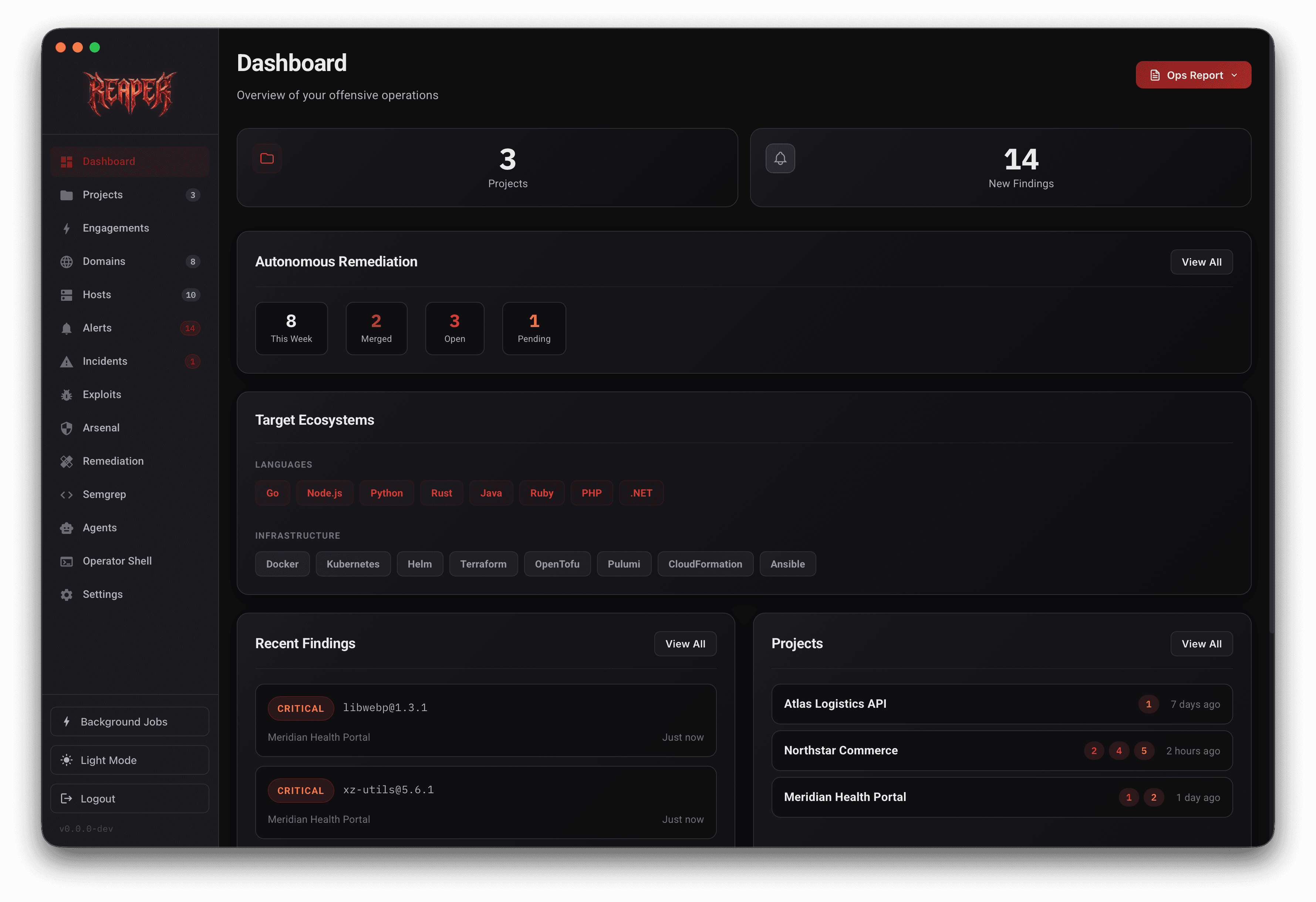
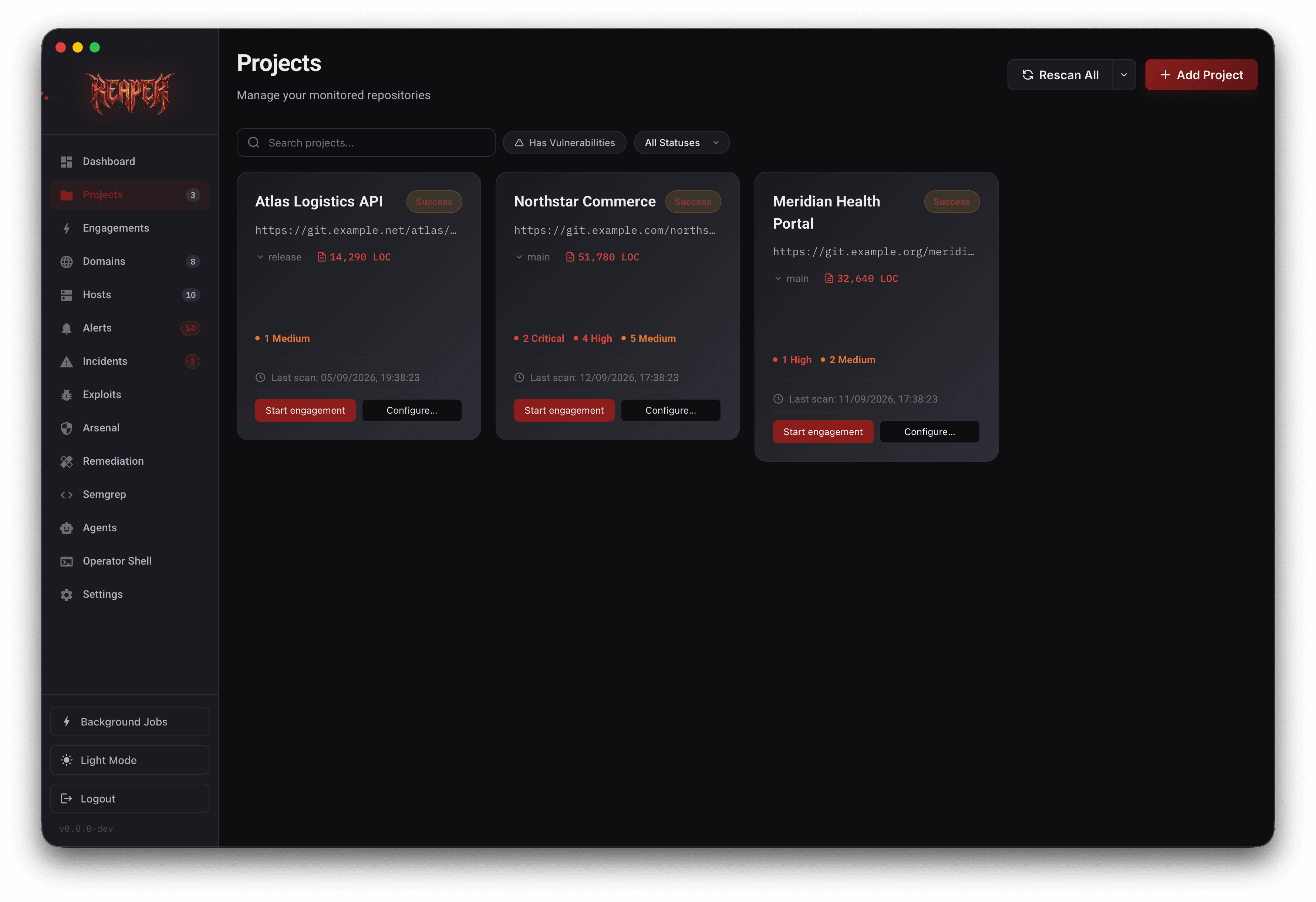
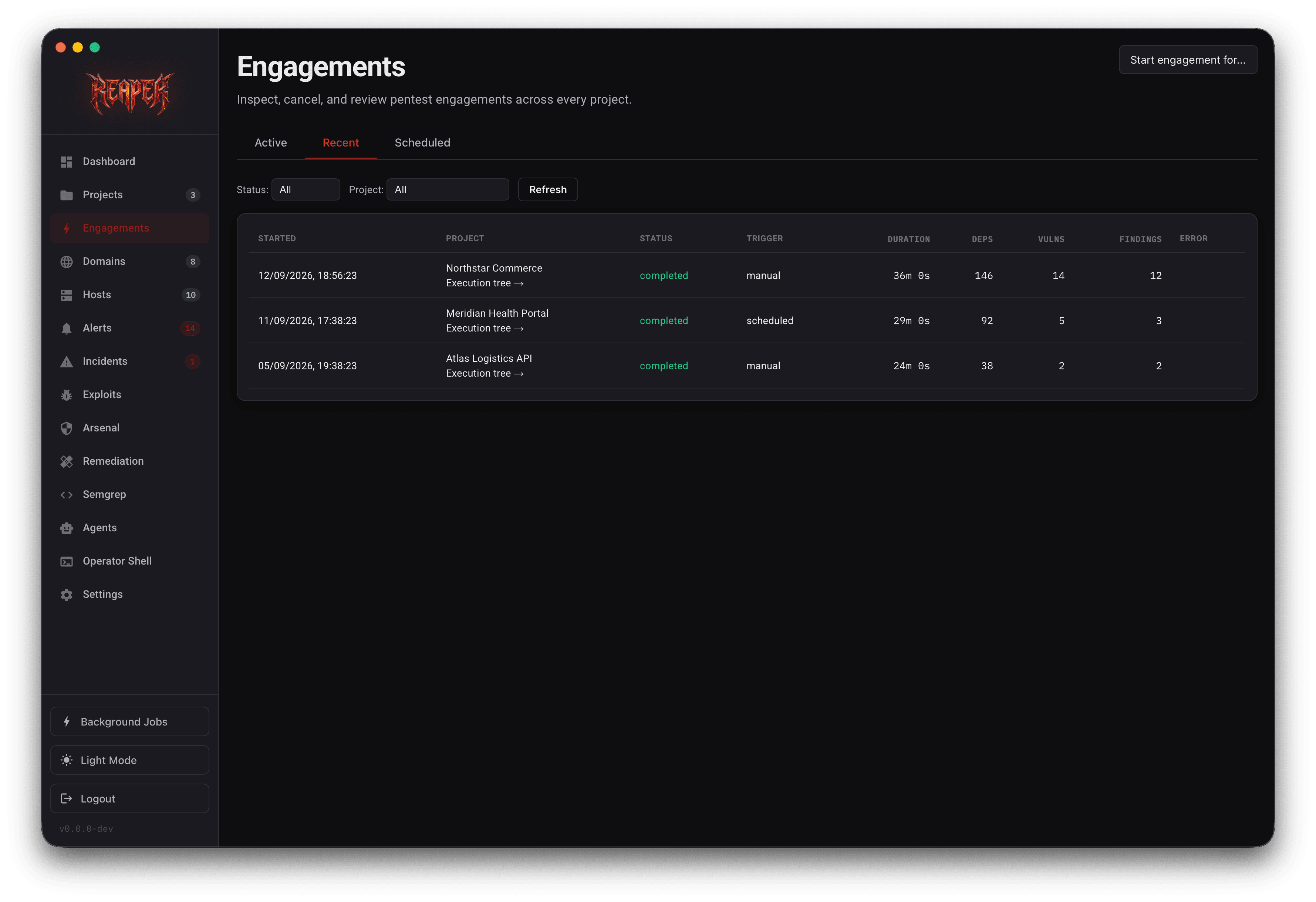
Follow one exposure from scope to finding
No scan is run here. The deterministic workspace shows how an authorized engagement narrows assets, records evidence, and prepares a reviewable finding.
Manual Pentesting Does Not Scale
A yearly pentest covers one week of a target that changes every day
Incomplete Coverage
Manual testers miss attack paths. No systematic way to enumerate every target across your infrastructure.
Slow Turnaround
Weeks between engagement start and final report. Findings are stale before they reach your team.
Inconsistent Quality
Results depend on the individual tester. No standardized methodology across engagements.
Eight Agents Run the Engagement
Recon, exploit selection, reporting, remediation and incident response each have a dedicated AI agent, with human checkpoints between the phases
Recon Agent
Automated target enumeration discovers services, technology stacks, and entry points that manual reconnaissance would miss.
Exploit Agent
AI selects exploits using the integrated exploit database — Exploit-DB, Metasploit modules, GitHub PoCs, and InTheWild active exploitation data. Generates and validates PoCs enriched with real-world exploit intelligence.
Pivot Agent
Plans exploit progression, shapes project-specific Semgrep coverage, and helps operators move from raw findings to validated attack paths.
Report Agent
Reports are written per audience: an executive summary for the board, attack narratives and remediation steps for the engineers.
Your AI Assistant Runs Ops
A built-in Model Context Protocol server lets Claude Code, Cursor, Windsurf, and other AI tools query security data, trigger engagements, generate PoCs, and manage remediation
Operate The Entire Offensive Workflow
From target onboarding to live engagements, incident handling, and fix PRs, Reaper keeps the offensive loop under one workflow
Target Integration
Connect repositories from GitHub, GitLab, Bitbucket, Azure DevOps, Gitea, or SVN. Bulk import targets and keep branch-aware projects synced to the code you actually ship.
Attack Surface Discovery
Automated passive DNS discovery, host resolution, service fingerprinting, and technology detection map the external surface before operators spend time by hand.
Exploit Intelligence
Sync exploit data from Exploit-DB, GitHub PoCs, Metasploit modules, and in-the-wild feeds so teams know which vulnerabilities already have working offensive context.
Live Engagements
Run active, recent, and scheduled engagements with live logs, execution trees, ETAs, and human decision checkpoints when an operator needs to approve the next move.
Project Workspaces
Each project becomes a control room for alerts, vulnerabilities, logs, reports, Semgrep coverage, AI review, access control, and settings.
Vulnerability Scanning
Nuclei, Nmap, ffuf, subfinder, httpx, katana, Semgrep, detect-secrets, grype, and trivy combine offensive discovery with code and dependency signal.
Deterministic Defensive Signal
Optional Guardian sidecar adds code scanning, dependency analysis, vulnerability matching, and license compliance, then feeds that ground truth straight into offensive planning.
Recon Agent
A 3-phase AI audit agent explores your codebase to find logic flaws, race conditions, TOCTOU bugs, and insecure design patterns that signatures miss.
AI Exploit Agent
Every finding and CVE is reviewed for real exploitability. Reaper generates proof-of-concepts and ranks findings by whether an attacker can actually reach them.
Rule Generation
A multi-agent pipeline generates project-specific Semgrep rules, validates them, and gives teams global and per-project control over custom security coverage.
Autonomous Remediation
Generate AI-authored fix PRs from alerts and findings, stream remediation progress live, and keep a central history of proposed code changes.
MCP Orchestration
Built-in MCP support exposes query, analysis, and action workflows so assistants can launch scans, inspect findings, create incidents, and open fix PRs conversationally.
Incident Response
Create incidents manually or bootstrap them from URLs, text, or PDFs. Track timelines, linked alerts, status transitions, and AI-written incident reports.
Agent Control Plane
Configure agents, edit prompts, tune rate limits, review run history, inspect memory, and monitor live activity from one operator-facing control surface.
Enterprise Controls
Support passkeys, SSO, SCIM, RBAC, API keys, OAuth apps, MCP org controls, and optional Kali sidecar execution without breaking the offensive workflow.
Download the Reaper Whitepaper
Offensive security platform covering attack-surface discovery, live engagements, AI-powered auditing, remediation, and MCP integration.
Connect Any Target
Point Reaper at a domain, an IP range, or a repository on any major Git host
GitHub
First-class GitHub App with OAuth installation flow, automatic webhook-driven scans on push and PR events. Also supports PAT and GitHub Enterprise Server.
GitLab
GitLab.com and self-hosted GitLab instances with custom URL configuration
Bitbucket
Bitbucket Cloud integration with workspace and repository access
Azure DevOps
Azure Repos integration with organization and project support
Gitea
Gitea and Forgejo self-hosted instances with configurable base URL
SVN
Apache Subversion support with full checkout capabilities for legacy systems
Operations Driven From a Prompt
Recon, exploit lookup and reporting, driven from a prompt
Stay up to date with Reaper
Release notes, technical deep-dives and product updates. No spam, and you can unsubscribe at any time.
Put Your Attack Surface Under Watch
Point Reaper at a domain and the first surface map lands in minutes. No credit card required.