Solution Whitepaper | Amsterdam Technologies
Reaper: Attack Surface Monitoring and AI-Assisted Penetration Testing Platform
The traditional penetration testing model is fundamentally misaligned with modern software delivery. Organizations deploy code continuously, yet they evaluate…
The Problem
The traditional penetration testing model is fundamentally misaligned with modern software delivery. Organizations deploy code continuously, yet they evaluate their security posture episodically. A yearly or quarterly penetration test covers only a point-in-time snapshot of an attack surface that mutates daily. Between these engagements, security teams rely on deterministic defensive scanners—Static Application Security Testing (SAST), Software Composition Analysis (SCA), and Cloud Security Posture Management (CSPM)—to bridge the gap.
This creates a systemic challenge: alert fatigue without exploitability context. Defensive scanners flag thousands of theoretical vulnerabilities, missing the nuanced logic flaws, race conditions, and chained exploit paths that human attackers actually use. Security and engineering teams are forced to manually triage massive backlogs, attempting to deduce whether a vulnerable dependency is actually reachable or if a misconfiguration can be weaponized in practice.
Furthermore, the operational tooling used in offensive security remains highly fragmented. Reconnaissance, exploit formulation, execution, and reporting require entirely separate toolchains. Operators must manually map findings from a passive DNS sweep into network scanners, export the results into exploitation frameworks, and eventually synthesize the outcomes into static PDF reports. This manual data serialization introduces severe latency, meaning findings are often stale before the engineering team receives the final report. The market requires a platform that combines the scale and frequency of automated scanning with the contextual exploitability verification of a human red team.
Solution Overview
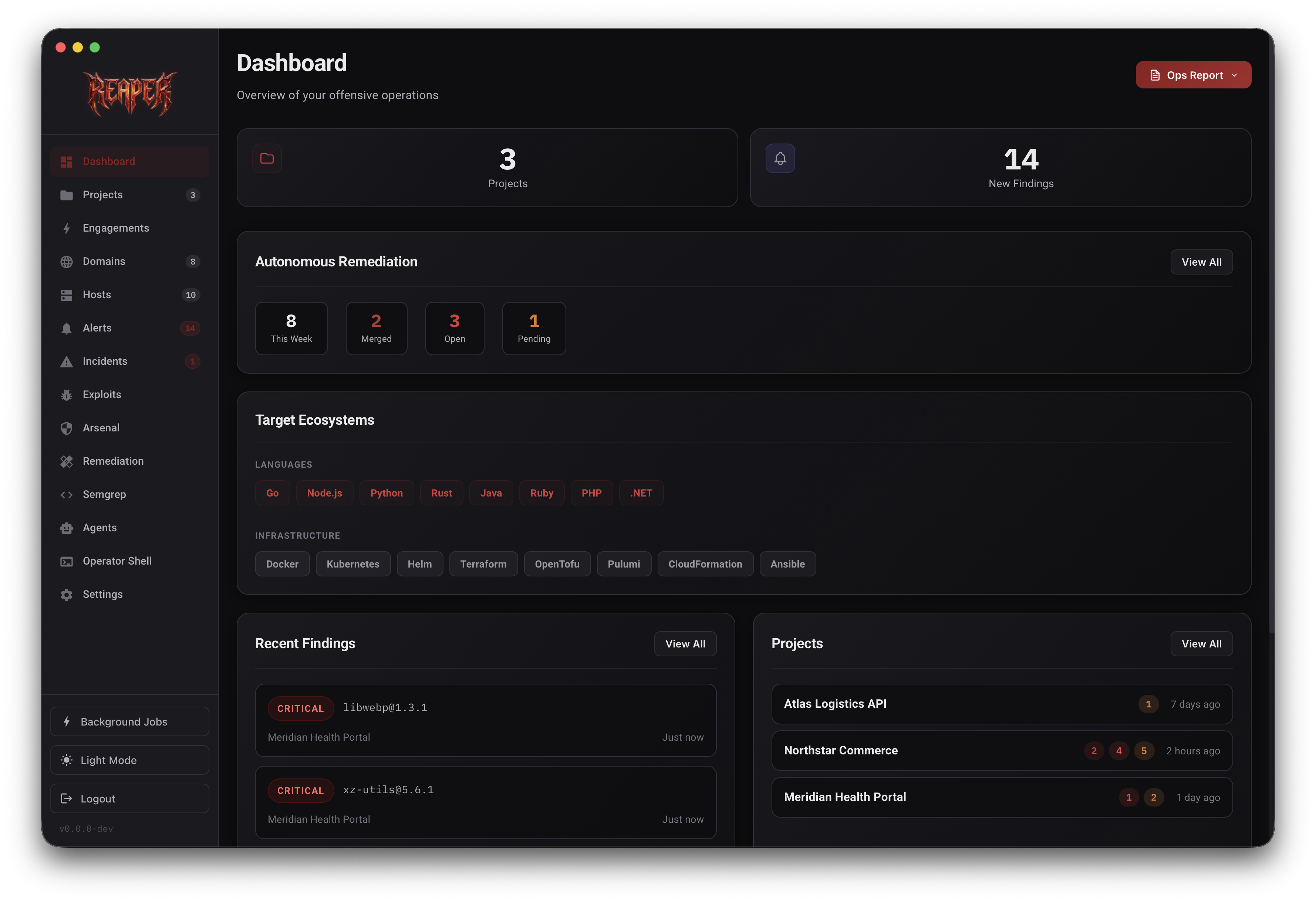
Reaper is an AI-driven offensive security platform that orchestrates continuous penetration testing, attack surface monitoring, and autonomous remediation. Rather than relying solely on static signatures, Reaper deploys a multi-agent artificial intelligence pipeline to actively reconnoiter targets, plan exploit paths, weaponize intelligence, and validate findings against live infrastructure.
The core architectural thesis of Reaper is the unification of deterministic defensive signals with non-deterministic offensive execution. It ingests standard vulnerability data and feeds it into a specialized suite of AI agents capable of operating a vast catalogue of active offensive tools. By wrapping industry-standard utilities, custom native probes, and physical hardware interfaces in a strict authorization boundary, Reaper allows AI models to safely execute real-world attack vectors.
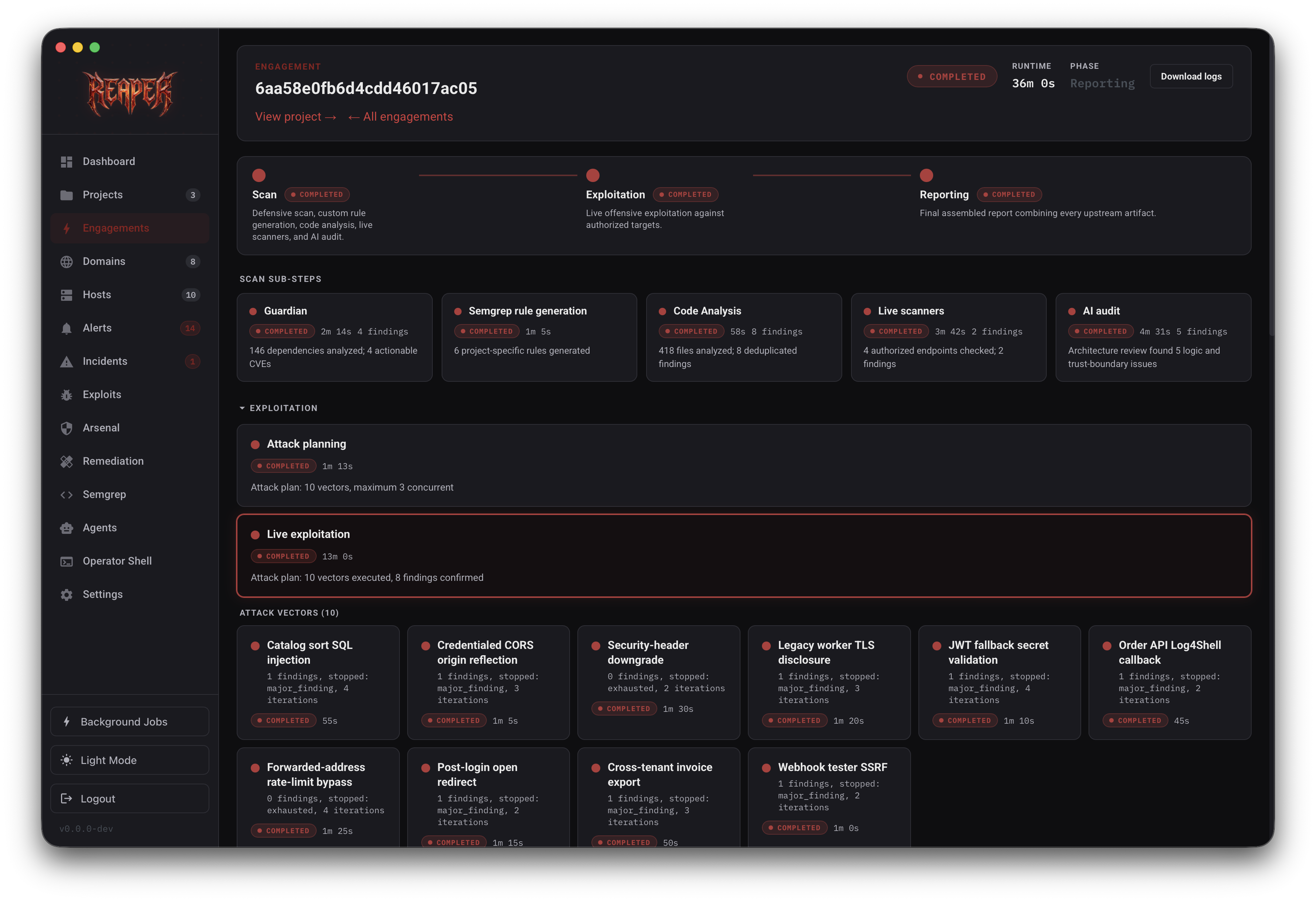
Every architectural decision in Reaper optimizes for high-signal, high-confidence results. By strictly separating the reconnaissance, exploitation, validation, and reporting phases, the platform ensures that only validated, reachable risks reach the final executive report. The result is a continuous, automated red-teaming capability that operates at the speed of modern CI/CD pipelines while maintaining the rigorous safety controls required for enterprise environments.
Key Capabilities
Autonomous Offensive Operations & Hardware Integration
Reaper orchestrates an 84-tool offensive catalogue spanning network reconnaissance, web application exploitation, and physical hardware auditing. Execution is entirely automated via specialized agents but bounded by strict organizational safety gates.
- Network & Web Exploitation: Through an isolated, opt-in Kali Linux execution sidecar, Reaper safely deploys standard offensive utilities like Nmap, SQLMap, and Metasploit auxiliary modules. The platform parses the raw output of these utilities deterministically, mapping the results back to the engagement state without exposing the underlying host environment.
- Physical Hardware Pentesting: Uniquely, Reaper extends its offensive capabilities to physical security via direct hardware integration. The platform supports RF signal analysis through HackRF One, JTAG/SPI/I²C debugging via Tigard, and direct CDC-ACM RPC interactions with Flipper Zero devices. These hardware tools are tightly controlled via per-device USB authorization, strict scope-hash drift detection, and 30-day transmit acknowledgments.
Specialized AI Agents & Expert Personas
The platform is powered by a multi-agent pipeline featuring nine specialized AI agents, each responsible for a distinct phase of the engagement lifecycle.
- Exploit Briefing & Planning: Before execution, an Exploit Briefing agent distills invariant context—target stacks, historical memories, and defensive scan results—into a compact markdown brief. This reduces prompt overhead by roughly 70%, allowing subsequent Exploit and Pivot agents to operate faster and with lower token consumption.
- Offensive Personas: Agents can be dynamically injected with specific offensive security personas, aligning their execution methodology with specialized disciplines (e.g., web exploitation, hardware reverse engineering, or logic flaw auditing).
End-of-Pipeline Validation & Triaging
To eliminate the false positives inherent in automated security tools, Reaper employs a dedicated End-of-Pipeline Validation Agent.
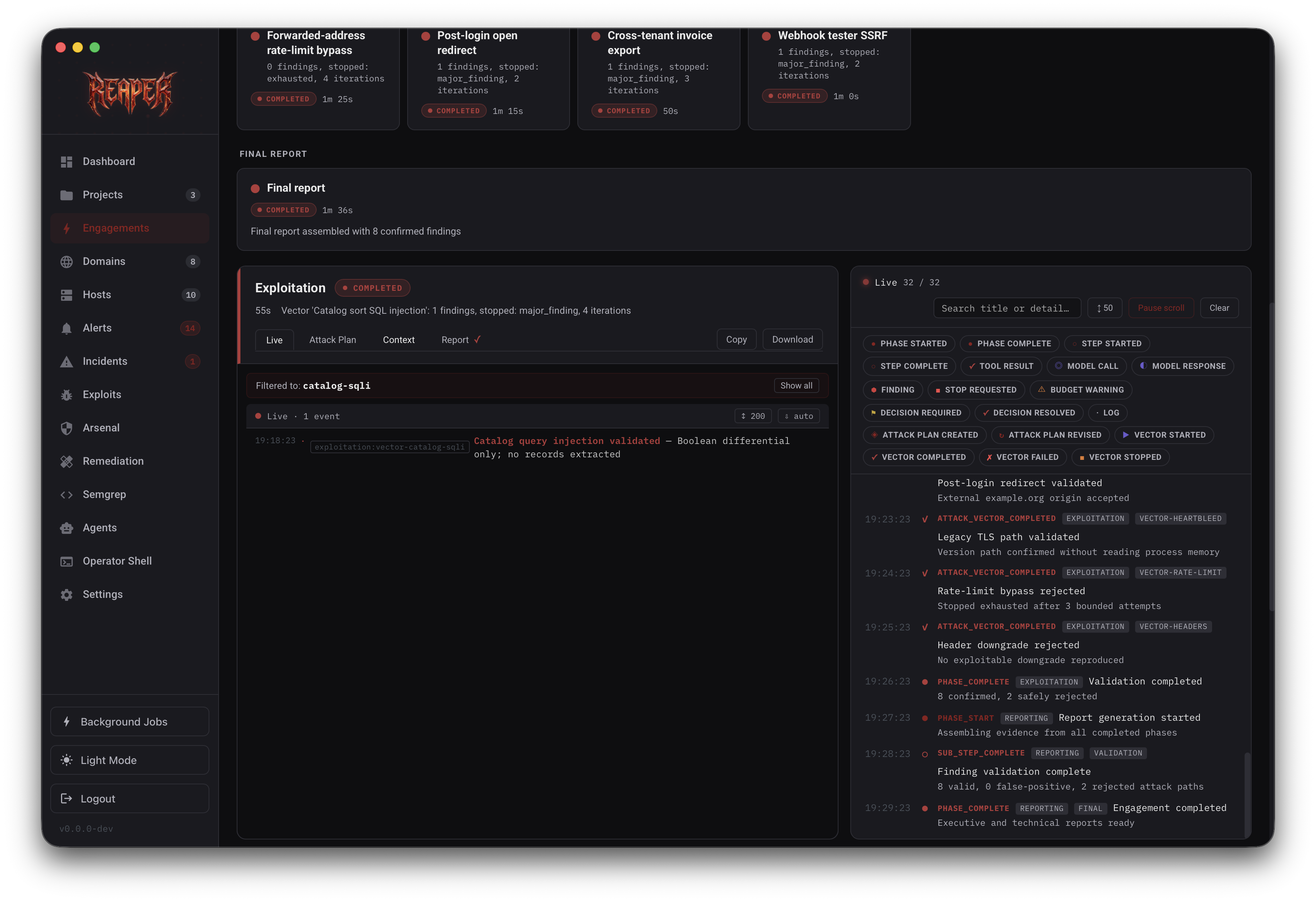
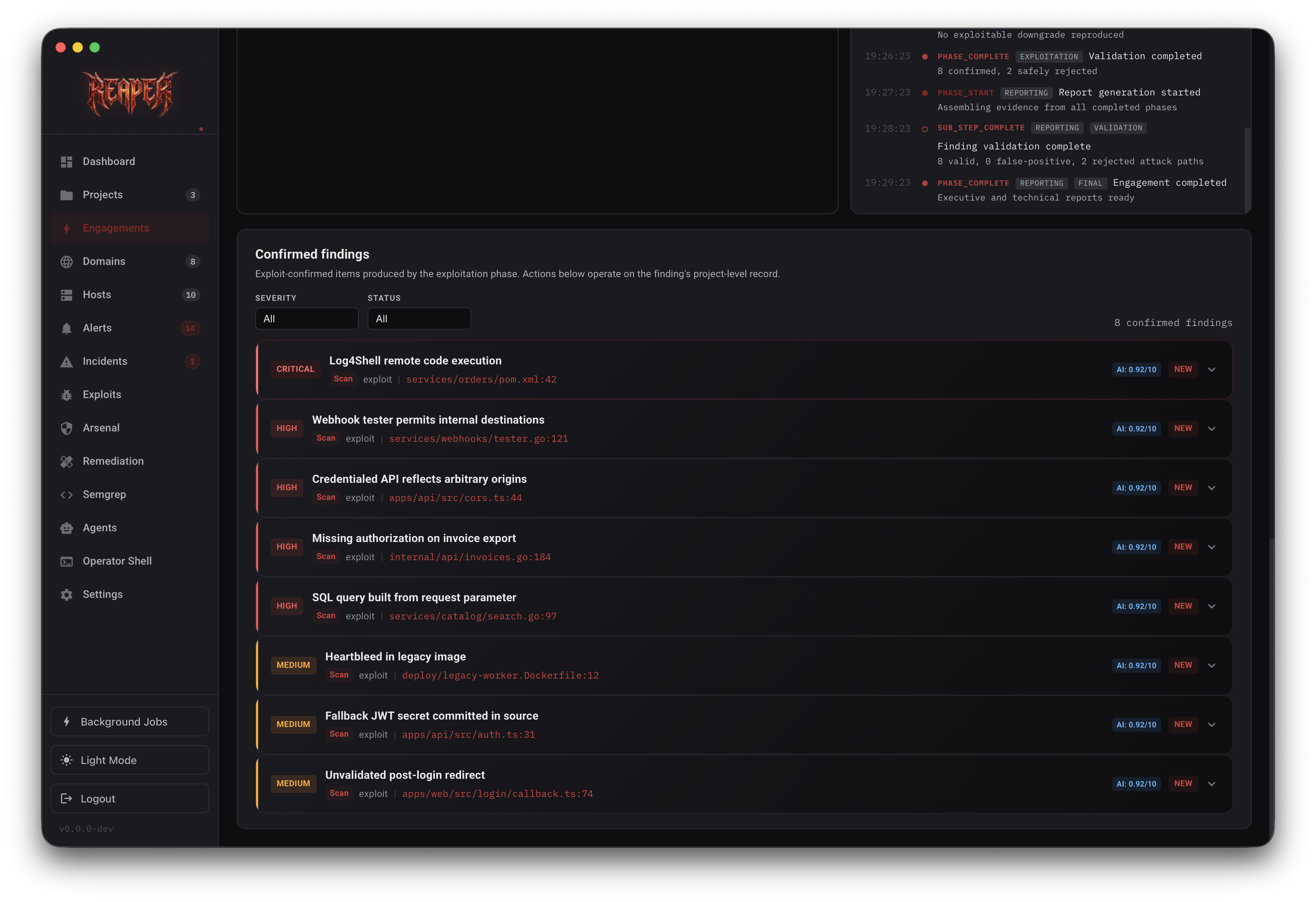
- 5-Class Verdict System: Before any exploited finding is reported, the validator re-examines the evidence and applies a rigorous five-class verdict (valid exploitable, valid mitigated, valid low impact, false positive, or inconclusive).
- Reachability Evidence Rules: The validator enforces hard, parser-driven logic rules. For example, a vulnerability cannot be classified as having a "Public" reachability radius without a direct citation from a live HTTP probe or route handler. This ensures severity scoring is based on empirical proof rather than probabilistic assumption.
Exploit Intelligence & Attack Surface Discovery
Reaper does not just scan; it contextualizes targets against live threat data and historical exposure.
- Multi-Source Intelligence: The platform maintains an offensive exploit-availability database, synchronizing actively exploited CVE feeds (InTheWild), Exploit-DB, GitHub proof-of-concepts, and Metasploit module maps.
- Continuous Reconnaissance: Utilizing passive DNS integrations and service fingerprinting, Reaper maps external domains, host resolutions, and technology stacks automatically, establishing the perimeter before active probing begins.
MCP-Powered Assistant Orchestration
Reaper natively implements the Model Context Protocol (MCP), exposing its capabilities to external AI assistants and IDEs.
- Agentic Workflows: With 35 distinct MCP tools, developers using clients like Claude Code, Cursor, or Windsurf can directly query the Reaper database, search the exploit intelligence feed, trigger localized project scans, and generate autonomous remediation pull requests entirely through conversational interfaces.
Deterministic Defensive Signal (Guardian)
While Reaper is fundamentally offensive, it seamlessly integrates defensive ground truth via the Guardian sidecar.
- Code & Dependency Signal: Guardian performs deep deterministic code scanning, dependency analysis, and CVE matching. Instead of presenting this as a separate alert queue, Reaper injects the Guardian markdown report directly into the Exploit Planner's context window, directing the offensive agents to attempt weaponization of the discovered dependencies.
Architecture & Technical Design
Reaper is engineered as a high-performance, distributed application designed for deployment flexibility and rigorous data isolation. The platform consists of a highly concurrent Go backend, a React-based frontend framework, and a document-oriented MongoDB persistence layer.
Architectural Philosophy & Microservices Reaper utilizes a sidecar architectural pattern to isolate risk and optimize execution environments. The core platform handles orchestration, authentication, state management, and LLM communication. High-risk execution environments are strictly isolated:
- Guardian Sidecar: Handles CPU-intensive deterministic defensive analysis (SCA, code parsing) in a dedicated container, writing to a logically separated database to prevent data contamination.
- Kali Sidecar: Offensive tools are executed inside an isolated, containerized Kali Linux network. The backend communicates with this sidecar via authenticated, argv-allowlisted API calls, completely eliminating shell-spawning risks on the core infrastructure.
Data Privacy & Multi-Tenant Security The platform is inherently multi-tenant, utilizing a robust Role-Based Access Control (RBAC) model. Tenant boundaries are enforced via JWT claims and strict query scoping. Crucially, Reaper employs a zero-fallback, per-user credential vaulting system. External credentials—such as AI provider API keys, Version Control System (VCS) tokens, and passive DNS credentials—are AES-256-GCM encrypted at rest using a 32-byte instance key. They are never read from global environment variables at runtime, ensuring that one user cannot inadvertently leverage another user's API access or prompt injection capabilities.
Observability & Telemetry For enterprise monitoring, Reaper integrates native OpenTelemetry (OTel) tracing. All LLM inferences, tool executions, and agent decisions emit standardized OTLP/HTTP spans detailing token consumption, conversation state, and execution latency. This telemetry pipeline integrates seamlessly with enterprise observability platforms like Datadog, Honeycomb, or Grafana without requiring intercepting proxies.
Use Cases & Scenarios
Continuous Enterprise Red Teaming
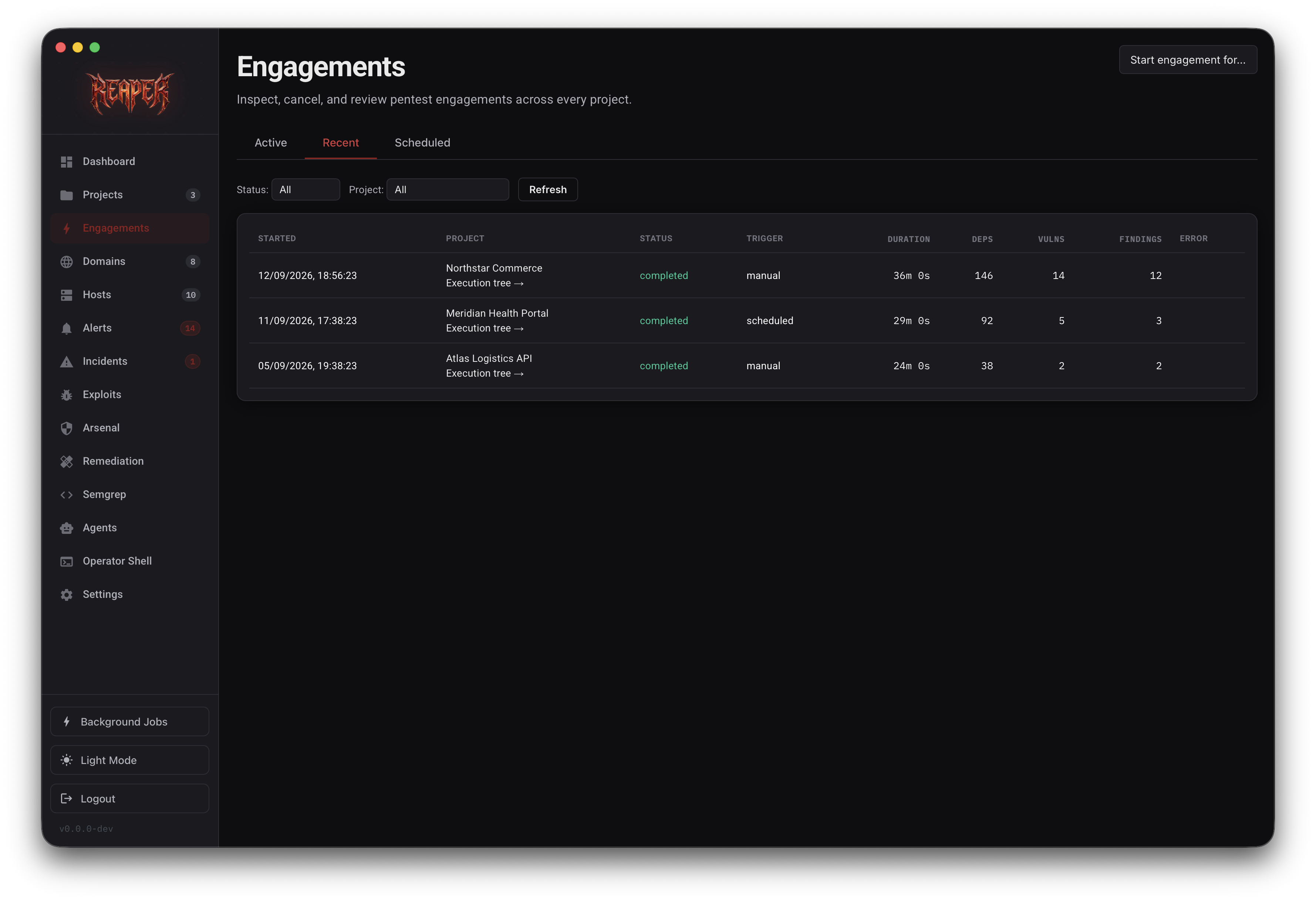
Context: A large financial institution deploys microservices daily but only conducts full penetration tests bi-annually, leaving a massive temporal gap in their security posture. Solution: The security team configures Reaper to continuously monitor their external IP ranges and primary domains. Using passive DNS discovery and the Recon Agent, Reaper automatically identifies a newly deployed API gateway with an outdated authentication module. The Exploit Agent cross-references this with the Exploit-DB feed, identifies a known bypass, safely executes a validation probe via the Kali sidecar, and confirms the vulnerability. Outcome: The risk is identified and validated with a working Proof-of-Concept within minutes of the deployment, rather than months later during an episodic audit.
Developer-Driven Security Remediation
Context: A platform engineering team is working inside an IDE and needs to assess the security impact of a major dependency update across multiple repositories. Solution: Using the native MCP integration, a developer queries their AI assistant (e.g., Cursor) to evaluate the update. The assistant interfaces with the Reaper MCP server, triggers a targeted Guardian dependency scan, and checks the results against the active exploit intelligence feed. Discovering a high-severity, actively exploited CVE in the proposed dependency version, the assistant utilizes Reaper's action tools to automatically generate a remediation pull request targeting a secure version. Outcome: Vulnerabilities are intercepted and remediated directly within the developer's workflow, shifting security entirely to the left.
Physical & RF Security Assessment
Context: An industrial control systems (ICS) security consultancy needs to evaluate the physical access controls and RF communication protocols of a manufacturing facility. Solution: Operators connect a HackRF One to their Reaper deployment. Using the dedicated hardware integration tools, Reaper's agents execute an RF sweep, classifying FSK/ASK signals and identifying an unencrypted command protocol used by the facility's localized sensor network. The execution is strictly bounded by authorized frequency ranges to prevent disruption. Outcome: The consultancy delivers a comprehensive, data-backed assessment of the physical attack surface, merging RF findings into the same executive report as the facility's web vulnerabilities.
Vulnerability Triage & Prioritization
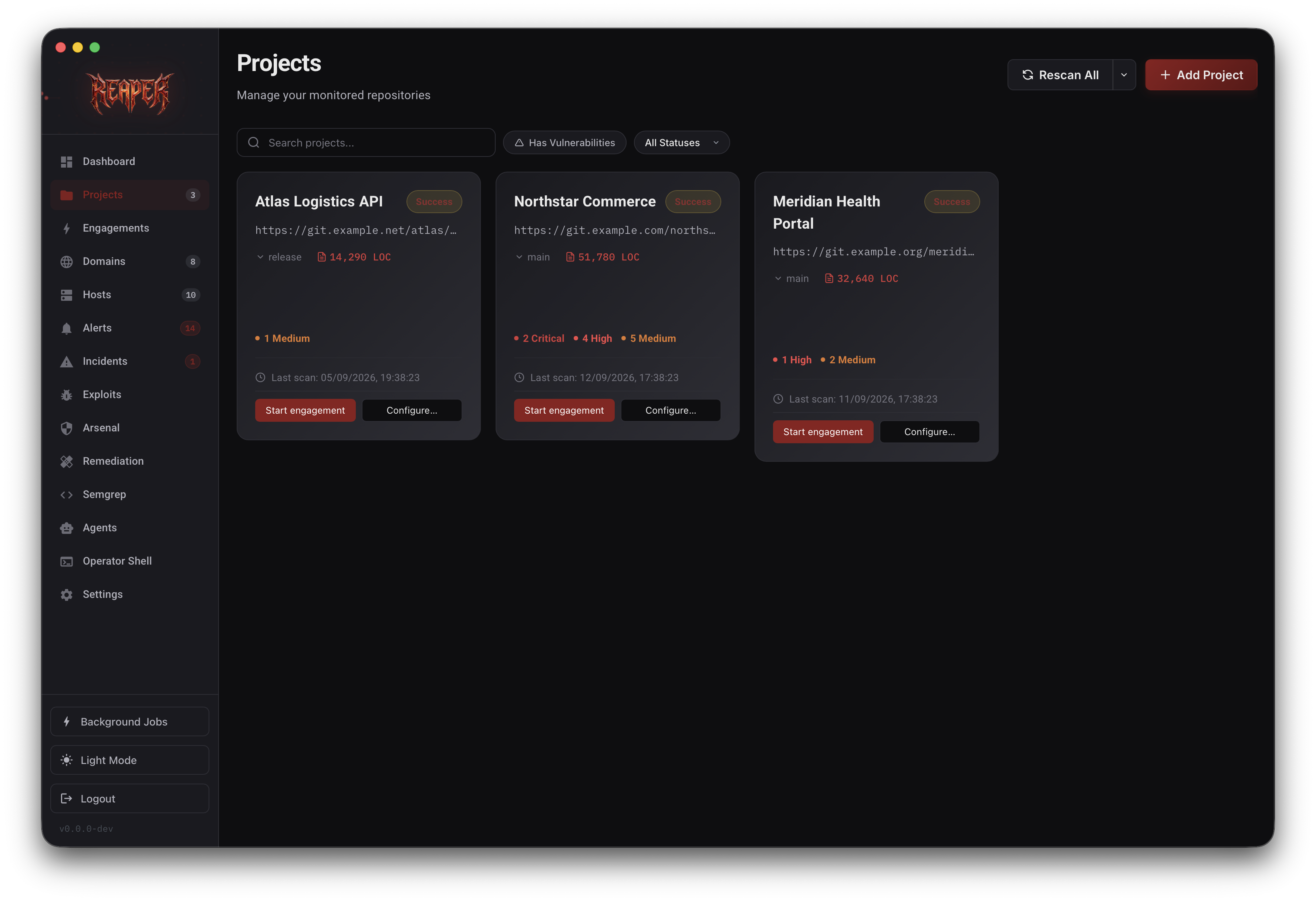
Context: A global e-commerce company’s legacy SAST tooling generates hundreds of cross-site scripting (XSS) and injection alerts daily, overwhelming the triage team. Solution: The team pipes their repositories into Reaper. Instead of manually reviewing alerts, Reaper’s End-of-Pipeline Validation Agent analyzes every finding. It executes AST-level code searches, local route handler analysis, and safe HTTP probes to determine reachability. The agent classifies 85% of the alerts as unreachable ("False Positive" or "Valid Low Impact") because they occur in local-only administrative scripts without public exposure. Outcome: The security team focuses exclusively on the 15% of findings with confirmed "Public" reachability and high blast radiuses, drastically reducing alert fatigue and improving time-to-remediation.
Pricing & Plans
Reaper is delivered as a cloud-hosted SaaS platform, with dedicated local-execution applications available for specific hardware testing requirements.
| Plan | Price | Key Features |
|---|---|---|
| Developer | Free / Pay-as-you-go | Cloud-hosted SaaS, single project, basic AI agents, standard scanning tools, manual MCP integration. |
| Professional | €499 / month | Cloud-hosted SaaS, up to 15 projects, full AI pipeline (Validator, Exploit Briefing), Guardian sidecar, priority support. |
| Enterprise | Custom | Unlimited usage, dedicated cloud instance or on-premise option, SSO/SAML integration, SLA guarantee, Kali/Hardware integrations, dedicated account manager. |
Pricing Philosophy: Our pricing is designed to scale with your operational footprint. Hosted SaaS plans ensure immediate onboarding and zero-maintenance infrastructure. For highly regulated environments or organizations requiring direct hardware sidecar execution, our Enterprise tier provides dedicated infrastructure, advanced SSO controls, and self-hosted deployment options.
Frequently Asked Questions
How does Reaper prevent AI agents from causing outages during active exploitation? Reaper enforces a multi-layered safety boundary. Agents do not have raw shell access; they interface with offensive tools through strongly typed API wrappers. Furthermore, aggressive scanning techniques and hardware-destructive operations are disabled by default and must be explicitly authorized via organizational RBAC controls and per-engagement scope limitations.
Are my proprietary source code and vulnerability data used to train the AI models? No. Reaper utilizes enterprise-grade AI provider integrations. Under standard configurations, data sent to models (like Claude or Gemini) via API is explicitly excluded from provider training sets. Furthermore, Reaper's strictly vaulted, per-user credential system ensures that your data remains isolated within your specific tenant boundary.
Can Reaper run entirely on-premise or in an air-gapped environment? Yes. While the standard Developer and Professional tiers are cloud-hosted SaaS, the Enterprise plan supports full on-premise deployments. When paired with the Claude CLI provider and a locally hosted LLM bridge, Reaper can operate entirely within a private network.
How does the hardware integration work without exposing the main infrastructure? Hardware tools (HackRF, Tigard, Flipper Zero) operate via a specialized, in-process execution bridge rather than container passthrough. This requires explicit USB serial authorization and hardware presence polling, ensuring that only explicitly approved physical devices can be utilized by the AI agents.
Why Amsterdam Technologies
At Amsterdam Technologies, we believe that defensive security cannot scale without an equal and opposite offensive capability. Headquartered in Amsterdam, our engineering-first culture focuses on building tools that do not just report theoretical risk, but empirically prove it. Reaper represents the culmination of this philosophy: an orchestration platform that brings the rigorous scrutiny of an elite red team to the continuous cadence of modern software delivery. By bridging deterministic defensive signals with AI-driven offensive execution, we empower security teams to find, validate, and fix vulnerabilities before they can be exploited.
Vision: The future of security is autonomous validation. The Reaper roadmap continues to push the boundaries of agentic orchestration, expanding our hardware analysis protocols and deepening our autonomous incident remediation pipelines.
- Website: https://reaper.amsterdam-technologies.com
- Contact: support@amsterdam-technologies.com
- Company: amsterdam-technologies.com
Product screenshots